PDF Download Curb Rights: A Foundation for Free Enterprise in Urban Transit
PDF Download Curb Rights: A Foundation for Free Enterprise in Urban Transit
Just what do you think about Curb Rights: A Foundation For Free Enterprise In Urban Transit as one that we present now? This is a wonderful publication that belongs to the upgraded recently publication to release. When great deals of individuals attempt to get this book trouble, you can be much easier to join with us and also seek for it for less complicated methods. And also this is you time to notify your close friend regarding this good information. Delivering the excellent information regarding this book to others will certainly alleviate after that not to get difficulty anymore, moreover for far better info.
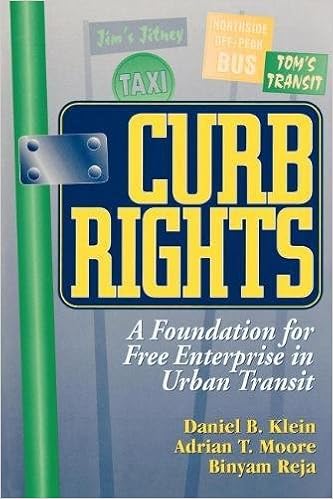
Curb Rights: A Foundation for Free Enterprise in Urban Transit

PDF Download Curb Rights: A Foundation for Free Enterprise in Urban Transit
Find the secret to be an effective individual who constantly updates the info and expertise. In this manner can be only exposed by accumulating the brand-new updates from numerous sources. Curb Rights: A Foundation For Free Enterprise In Urban Transit becomes one of the options that you could take. Why should be this book? This is the book to advise because of its power to evoke the info and sources in always upgraded. One likewise that will make this publication as referral is likewise this has the tendency to be the most recent book to publish.
If you still feel perplexed to choose guide as well as you have no idea regarding what kind of book, you could consider Curb Rights: A Foundation For Free Enterprise In Urban Transit Why should be it? When you are looking a book to be reviewed, you will take a look at the cover style at first, will not you? It will certainly likewise be the method of you to be interested to see the title. The title of this publication is additionally so interesting to read. From the title, you could be interested to check out the content.
What do you consider this publication? Are you still perplexed with this publication? When you are actually interested to read based upon the title of this publication, you can see exactly how guide will provide you numerous points. It is not only about the exactly how this publication worry around, it has to do with what you could extract from guide when you have actually reviewed. Even that's only for couple of pages; it will help you to give additional ideas. Yeah, Curb Rights: A Foundation For Free Enterprise In Urban Transit is extremely unbelievable for you.
fter reading this publication, you could realize exactly how individuals are taking this book to read. When you are stressed making much better choice for analysis, this is the best time to obtain Curb Rights: A Foundation For Free Enterprise In Urban Transit to read. This book supplies something new. Something that the others doesn't' offer it; this is one that makes it so special. And now. Release for clicking the link as well as get this book quicker. By getting it as soon as possible, you can be the first people that review it in this world.
From the Back Cover
The authors of this book say it's time to rethink the fundamental structure of transit policy. The book focuses on street-based transit - buses, shuttles, and jitneys. The authors propose that urban transit be brought into the fold of market activity by establishing property rights not only in vehicles, but also in curb zones and transit stops. Market competition and entrepreneurship would depend on a foundation of what they call "curb rights". By creating exclusive and transferable curb rights (to bus stops and other pickup points) leased by auction, the authors contend that American cities can have the best of both kinds of markets - scheduled (and unsubsidized) bus service and unscheduled but faster and more flexible jitneys. They maintain that a carefully planned transit system based on property rights would rid the transit market of inefficient government production and overregulation. It would also avoid the problems of a lawless market - cutthroat competition, schedule jockeying, and even curbside conflict among rival operators. Entrepreneurs would be free, able, and driven to introduce ever better service, revise schedules and route structures, establish connections among transit providers, facilitate passenger interchange, introduce new vehicles, and use new pricing strategies. And travelers would find public transit more attractive than they do now.
Read more
Product details
Paperback: 164 pages
Publisher: Brookings Institution Press (January 1, 1997)
Language: English
ISBN-10: 0815749392
ISBN-13: 978-0815749394
Product Dimensions:
6 x 0.4 x 9 inches
Shipping Weight: 8 ounces (View shipping rates and policies)
Average Customer Review:
3.3 out of 5 stars
3 customer reviews
Amazon Best Sellers Rank:
#4,120,949 in Books (See Top 100 in Books)
The authors suggest a hybrid system of urban mass-transit consisting of both privately-owned, flexibly-scheduled & routed and public-owned, fixed scheduled & routed bus systems. In order to prevent the flexibly-scheduled system from parasitically skimming passengers from the fixed route system, the authors suggest the promotion of "curb rights" to separate the operations.This would allow the predictably high-volume routes to be served by the high-volume, large bus & cost overhead municipal operation while allowing the service increases possible through the addition of smaller and possibly innovative operators.Makes sense to me. While clearly advocating their position, the authors recognize and address the ligitimancy of the municipalities' concerns over service preservation. With sensible implentation, I'm sure it would work to improve urban transit which (it seems to me) currently consists of balancing the interest of car-driving taxpayers to limit transit subsidies and the interests of Municipal Transit Agency employee unions to maximize employee wages and benefits, with the transit customer well down on the list of concerns.
There would be no need to take a "survey on how customers felt before and after deregulation." The "survey" would be expressed by customers voluntarily using the service, i.e. whether they were willing to purchase rides on deregulated transit vehicles. If customers were satisfied, the transit company would prosper. If not, they would go out of business and another company could enter the market and provide satisfactory service. That is the only survey that counts! If that's too much Econ 101 speculation, then you just don't get it!
I wouldn't spend any money on this book. The theory espoused in this book is so far from reality, it isn't funny.This book promotes the notion that "free enterprise" must be inserted into public transit so as to maximize the benefits to passengers and society at large.However, this notion is demonstrably wrong.For example, local bus operations in British cities outside of London were completely de-regulated in the 1980's by the national Tory government, e.g., public funding was almost entirely cut off and private bus companies were allowed to compete freely against one another (as opposed to "privatization" in the U.S. which has mainly meant a public agency putting service out to competitive bid). Regional pass schemes allowing passengers to freely transfer from one route or operator to another were abolished.The results are conclusive. Bus patronage in British cities dropped more than 30% by the early 1990's. In London, bus patronage over the same period actually increased somewhat, despite major cuts in subsidy funding. The difference was that London retained regional governmental control of fare and service decisions, despite putting much of the service out to bid.The disaster of British local bus de-regulation has also been repeated in spades by the ill-considered "privatization" of British Rail. Rail privatization has been a big enough disaster to become one of the hottest public issues in Great Britain.The successes obtained by "centralized" regional planning and decision-making authority in elected government hands is quite conclusive in other countries. In Zurich, per capita transit usage is among the highest in the developed world, exceeding a number of Japanese cities. Zurich's success--in one of the most affluent, high auto-owning urban areas on the planet--is based on centralized planning at the canton level, plus generous government funding. Zurich has managed to retain very high transit market share despite rapid motorization since the 1960's. The reasons that Toronto, Canada's past success with generating high transit usage levels, are essentially the same as Zurich, though the current pseudo-free market provincial government in Ontario is too boorish to understand this."Free market" economists like Klein often cite the "success" of private transit in Southeast Asia; however, those "capitalist" bastions of Hong Kong, Singapore, and Malaysia have relied on centralized planning and sufficient funding to allow new transit systems to function through selective privatization, but not anywhere near the model that Klein espouses. In effect, government transportation policies in Hong Kong and Singapore guarantee the transit market (e.g., car use is restricted, heavily taxed). The Zurich and Toronto models have proven to be less authoritarian.Klein proves how blinkered economists--particularly those who espouse "libertarian" views ("new right" in British and Australian terms)--are very shortsighted about public transit and other similar public policy issues.For one of the few books that I've seen that "gets it right," I recommend "A Very Public Solution" by Paul Mees, a professor of Planning and Public Policy at Melbourne University, Melboune, Australia (yes, Amazon carries it).Mee's point about urban transit is best summed up by this from one of my unpublished papers:Flexibility would be the greatest benefit of improved transit to "transit dependents" and would-be "choice" users. This is clearly explained by the book "A Very Public Solution" (Page 289; Dr. Paul Mees, Melbourne University Press, 2000. Melbourne, Australia):(Mees' excerpt):With public transport itself, the critical issue is flexibility. And the key to flexibility for passengers is simplicity and predictability, not a bewildering array of constantly changing options. The latter produces confusion, not convenience. Paradoxically, to be flexible, public transport must also be rigidly predictable: perhaps the best analogy is with the road system, rather than with cars themselves...This means that frequent service on an easy-to-understand, predictable, and reliable network of regional and local transit services delivers vastly superior flexibility to the customer. Such transit systems typically service a far higher percentage of "choice" patronage. Compared to an infrequent, specialized, hard to understand jumble of routes, such transit networks compete successfully with automobiles.A Very Public Solution's prime case study is Toronto, Canada. Toronto has significantly higher per transit usage per capita than many European cities, an order of magnitude higher than most U.S. urban areas. Toronto's exceptionally high transit use occurs despite millions of residents living in dispersed suburbs essentially indistinguishable from the American norm. Canadian fuel prices are only slightly higher than the United States. There are more similarities than differences between Canadian and U.S. culture. Toronto's transit usage remain high, despite service cuts caused by an early 1990's recession.
Curb Rights: A Foundation for Free Enterprise in Urban Transit PDF
Curb Rights: A Foundation for Free Enterprise in Urban Transit EPub
Curb Rights: A Foundation for Free Enterprise in Urban Transit Doc
Curb Rights: A Foundation for Free Enterprise in Urban Transit iBooks
Curb Rights: A Foundation for Free Enterprise in Urban Transit rtf
Curb Rights: A Foundation for Free Enterprise in Urban Transit Mobipocket
Curb Rights: A Foundation for Free Enterprise in Urban Transit Kindle


0 komentar: