Download A Short History of Financial Euphoria (Penguin Business), by John Kenneth Galbraith
Download A Short History of Financial Euphoria (Penguin Business), by John Kenneth Galbraith
It is not only to provide you the very easy method yet also to get guide is soft file systems. This is the reason you could get guide immediately. By connecting to net, your opportunity to locate as well as get the A Short History Of Financial Euphoria (Penguin Business), By John Kenneth Galbraith asap. By clicking web link that is proffered in this website, you can go to directly the book site. And also, that's your time to obtain your favorite publication.
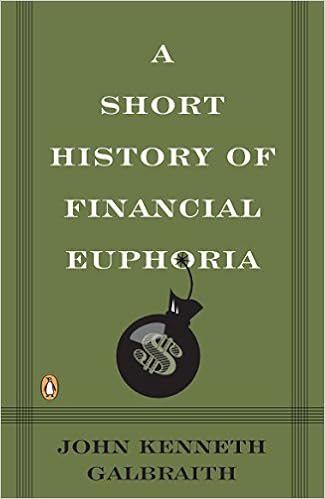
A Short History of Financial Euphoria (Penguin Business), by John Kenneth Galbraith

Download A Short History of Financial Euphoria (Penguin Business), by John Kenneth Galbraith
Have you found a brand-new publication to meet your holidays to review? Do you prepare for looking it? When somebody just have strategies to have holidays and also trips to go with some individuals, there a few other who also search for the books to use the leisure time. It is not type of difficult means to overcome this issue. Nowadays, the sophisticated technology is concerned in order to help you in doing anything.
The other intriguing books might be selections. You can discover them in also eye-catching title. However, what make you attracted to choose A Short History Of Financial Euphoria (Penguin Business), By John Kenneth Galbraith is that it features various style as mentioned. The language comes from be the simple language use. How the writer shares to the readers is very clear as well as readable. It makes you really feel simple to recognize exactly when the author speaks about.
You can alter point of how reading will provide you much better option. Yeah, A Short History Of Financial Euphoria (Penguin Business), By John Kenneth Galbraith is a book produced by a specialist author. You could take this kind of book in this website. Why? We provide the billions types and also catalogues of guides worldwide. So, actually, it is not only this publication. You could discover various other book types to be your own. The means is extremely simple, find the web link that we provide as well as obtain guide faster. Always try to be the very first person to read this book is extremely fun.
When someone should understand something, this book will possibly aid to find the response. The reason why analysis A Short History Of Financial Euphoria (Penguin Business), By John Kenneth Galbraith is a should is that it will certainly provides you a new means or far better way. When a person aims to make an initiative to be success in particular point, it will assist you to understand how things will be. Well, the very easy method is that you might get involved straight to act in your life after reading this book as one of your life resources.
From Publishers Weekly
The renowned Harvard economist examines reckless speculative episodes in American financial history. Copyright 1994 Reed Business Information, Inc.
Read more
About the Author
John Kenneth Galbraith was born in 1908 in Ontario, Canada. He earned a PhD at the University of California in 1934 and later took a fellowship at Cambridge, where he first encountered Keynesian economics. At different points in his life he taught at both Harvard and Princeton, and wrote more than forty books on an array of economic topics. During World War II he served as deputy head of the Office of Price Administration, charged with preventing inflation from crippling the war efforts, and also served as the US Ambassador to India during the Kennedy administration. He passed away in 2006.
Read more
Product details
Series: Penguin Business
Paperback: 128 pages
Publisher: Penguin Books; Reprint edition (July 1, 1994)
Language: English
ISBN-10: 0140238565
ISBN-13: 978-0140238563
Product Dimensions:
5 x 0.4 x 7.7 inches
Shipping Weight: 3.2 ounces (View shipping rates and policies)
Average Customer Review:
4.2 out of 5 stars
58 customer reviews
Amazon Best Sellers Rank:
#54,104 in Books (See Top 100 in Books)
I loved this book, but if you're looking for specific details about a given crisis, such as the Great Depression, you're going to be disappointed. Galbraith is looking at a bigger picture. He's writing about a pattern of crises -- a gestalt -- where the whole clearly transcends the explanations advanced for each of its parts. Viewed from that perspective, the author reveals an astonishing similarity in how such periods of financial euphoria followed by crisis keep recurring -- and how, after the fact, all the experts come out of the woodwork happy to explain why it happened. That is profound.Patterns tell a story not recognizable from studying the specific events. As we've all observed in our interpersonal dealings, most people can readily explain their behavior on a given occasion, say, getting in a fistfight, but can't explain their habit of getting in fights. The same applies to history's many wars. A study of the facts and circumstances underlying the "War of the Roses" (1455-1485) may explain who were the good guys and who the bad guys, but it can't explain why mankind keeps getting into wars.This book explains a historical pattern of booms and busts. In light of the Financial Crisis of 2008, it's arguably more pertinent today than it was when published in 1994. I'm currently reading Matt Taibbi's, "The Divide: American Injustice in the Age of the Wealth Gap" (2014). The author clearly thinks 2008 revealed a huge criminal conspiracy, witness the fact that he uses the word "fraud" at least 100 times. Other books such as Christopher Hayes's "Twilight of the Elites" beat the same drum.While such demagoguery is appealing, I'm still going with Galbraith: It seems nobody ever sees a crash coming, including the greedy participants at the heart of it. You can say the mortgage bubble was wrong, but it's the same kind of wrong that caused thousands of people to spend crazy amount of money on a single tulip bulb 370 years ago.
A Short History of Financial EuphoriaJohn Kenneth GalbraithBook ReviewBy Richard E. NobleThis book is indeed a "short" history of Financial Euphoria. I would have liked a much longer and more detailed history by Mr. Galbraith.In a previous book, "The Great Crash 1929," much of what is in this book has already been expressed. In fact, I think most of this work was excerpted directly from the "The Great Crash" verbatim.The advantages of this little book are that all these cases of speculative mania and fraud are lumped together in this one volume with updated commentary and some modern day comparisons. The author covers these type incidences up to the crash of 1987 in the later part of the Reagan administration.The author makes the point that all of these mania, panics or crashes have similar components. They are all based on speculation and leveraging.The mania is attributed to basic insanity and the misguided notion that because someone is rich he must therefore be wise."In the first forward to this volume, I told of my hope that business executives, the inhabitants of the financial world and the citizens of speculative mood, tendency or temptation might be reminded of the way that not only fools but quite a lot of other people are recurrently separated from their money in the moment of speculative euphoria. I am less certain than when I then wrote of the social and personal value of such a warning. Recurrent speculative insanity and the associated financial depravation and larger devastation are, I am persuaded, inherent in the system. Perhaps it is better that this be recognized and accepted."There are two types of speculators who invariably get involved in these troublesome episodes or "bubbles.""There are those who are persuaded that some new price-enhancing circumstance is in control, and they expect the market to stay up and go up, perhaps indefinitely. It is adjusting to a new situation, a new world of greatly, even infinitely increasing returns and resulting values. Then there are those, superficially more astute and generally fewer in number, who perceive or believe themselves to perceive the speculative mood of the moment. They are in to ride the upward wave; their particular genius, they are convinced, will allow them to get out before the speculation runs its course. They will get the maximum reward from the increase as it continues; they will be out before the eventual fall."He points out that warnings about the temperamental nature of the present boom are never heeded and those who offer them are looked upon with derision."In the winter of 1929, Paul M. Warburg, the most respected banker of his time and one of the founding parents of the Federal Reserve System spoke critically of the then current orgy ... and said that if it continued, there would ultimately be a disastrous collapse ... He was held to be obsolete in his views, `he was sandbagging American prosperity.'"This danger of speaking out against the speculative orgy as it is taking place often makes the bearer of such tidings the accused when the bubble finally bursts. It is a lose/lose situation in Mr. Galbraith's estimation. Yet he points out that he did the same himself in 1986 ... to no avail and much acrimony.So the speculative bubbles come and go and are endemic to the capitalistic system according to the Professor. He also suggests that they are cyclical. They reoccur every twenty or thirty years. They are directly proportional to the amount of time necessary for the previous fiasco to be forgotten and a new generation of semi-educated fools take their positions in the financial community."The circumstances that induce the current lapses into financial dementia have not changed in any truly operative fashion since the Tulipomania of 1636-1637. Individuals and institutions are captured by the wondrous satisfaction from accruing wealth. The associated illusion of insight is protected, in turn, by the oft noted public impression that intelligence, one's own and that of others, marches in close step with the possession of money..."The mistaken notion that since a person is rich he must be intelligent is emphasized over and over throughout the short text.So what is Mr. Galbraith's solution?"The only remedy, in fact, is an enhanced skepticism that would resolutely associate intelligence with the acquisition, the deployment, or, for that matter, the administration of large sums of money ... there is the possibility, even the likelihood, of self-approving and extravagantly error-prone behavior on the part of those closely associated with money ... a further rule is that when a mood of excitement pervades a market or surrounds an investment prospect, when there is a claim of unique opportunity based on special foresight, all sensible people should circle the wagons; it is the time for caution ... Yet beyond a better perception of the speculative tendency and process itself, there probably is not a great deal that can be done. Regulation outlawing financial incredulity or mass euphoria is not a practical possibility."This conclusion I find very interesting and extremely disappointing. After all his great insight and explanation of the circumstances precipitating these speculative fiascos he closes with: Regulation outlawing financial incredulity or mass euphoria is not a practical possibility.This conclusion appears somewhat demented also. Mr. Galbraith, it appears, has completely forgotten that in most of these cases a crime was committed and that the euphoria involved was not inclusive of the masses, as he states, but of a select group of people within the masses reigning in the financial community.The Tulipomania is rather unique. It seems to be the perfect example of innocent mass insanity. But most of the other cases involve crime and criminal personalities not simply a massive delusion. There was swamp land in the 20's in Florida involving everyone's favorite con-man, Charles Ponzi. There were gold mines that didn't exist and were never worked or mined. There were worthless stocks and bonds and real criminals involved in the various scams.During the course of the book the author mentions that some of these individuals were punished with prison sentences or ostracized, and "justifiably so" says he.Instead of fraud he now seems to be defining the criminal behavior involved in each of these scandals as "inciting financial incredulity or mass euphoria" which, I agree, would be difficult to prosecute.Where is his outrage for the crimes and criminals involved?I find it interesting to note that if a man robs a corner store with a gun and steals one hundred dollars, he will most likely end up in prison. The man or the men who rob millions of innocent people of their assets through fraud and other criminal shenanigans are given an indifferent shrug by Mr. Galbraith. "Oh dear, what to do?" seems to be the gist of it.In our last scandal that nearly collapsed the economy of the entire world we clearly had criminal fraud, falsifying of documents, false testimony, false accounting procedures and figures and basic embezzlement.Most of us were victims yet not participants in the speculative mass euphoria - just as in 1929 and in other of these big financial calamities.We bought nothing and sold nothing. Yet when the final tabulations were given we lost tens of thousands, and some of us hundreds of thousands on our home equity and life savings. Our retirement pensions were looted.A property that was estimated before the euphoria at $125,000 may now be estimated at $50,000 or less.Because of the indulgences of the speculative euphoria in the financial and real estate sector we are all made to suffer and pay dearly. And the bandits are not even being pursued by a posse.It seems that this was the mindset of those involved. They knew they were acting criminally but made the calculation that as long as the majority in their industry participated in the crime, they would be in effect "too many to be prosecuted."It now appears that they were correct. We have an obvious case here of "Crime and No Punishment."This indicates to me that this criminal behavior is far from over. The thief who is successful in his thievery is encouraged to rob again. The next massive robbery seems to me to be just a matter of time and manipulation.At the beginning of this review I pointed out that Mr. Galbraith suggested that all of this business is inherent in the capitalist system - it is not only systemic but endemic. And now we find that it is also incurable and beyond regulation and justice.So then we are to sit back and periodically - every twenty years or so - let our wealthier sector rob us of all or part of whatever it is we thought to be our little nest egg or share in this great society. Crime on the part of certain groups among us is inevitable and any type of preventative attempt on the part of us or society is futile.If that is the reality of the capitalistic system, then maybe it is time to take a closer look at this capitalist system.This is like saying: Men will rape women. So girls, ready yourselves for the event and get used to it.This is very poor logic coming from a very intelligent man.I need a better solution than what the good Professor is offering here.Unfortunately, Mr. Galbraith died before this last economic disaster. I wish he lived to tell us his thoughts on this situation.Richard Edward Noble is a writer and author of: "Bloggin' Be My Life."
A Short History of Financial Euphoria (Penguin Business), by John Kenneth Galbraith PDF
A Short History of Financial Euphoria (Penguin Business), by John Kenneth Galbraith EPub
A Short History of Financial Euphoria (Penguin Business), by John Kenneth Galbraith Doc
A Short History of Financial Euphoria (Penguin Business), by John Kenneth Galbraith iBooks
A Short History of Financial Euphoria (Penguin Business), by John Kenneth Galbraith rtf
A Short History of Financial Euphoria (Penguin Business), by John Kenneth Galbraith Mobipocket
A Short History of Financial Euphoria (Penguin Business), by John Kenneth Galbraith Kindle


0 komentar: