PDF Ebook Financial Instrument Pricing Using C++ (Wiley Finance)
PDF Ebook Financial Instrument Pricing Using C++ (Wiley Finance)
To obtain Financial Instrument Pricing Using C++ (Wiley Finance), no challenging system as well as no hard working to get this book exist. Connect your computer system, laptop computer, or gizmo with the net. Now, you could click the link and also get download with the terms that are in the web link. After getting it and also saving the soft file of Financial Instrument Pricing Using C++ (Wiley Finance), you could begin as well as manage where when you will certainly read it. This is a very amazing task to be behavior and a hobby.
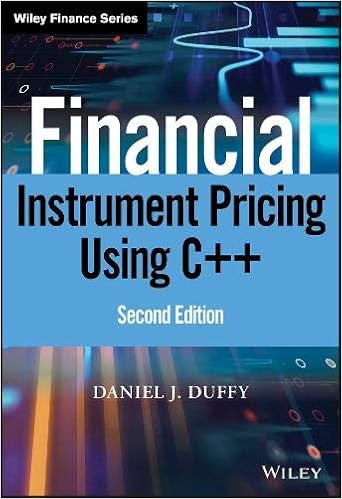
Financial Instrument Pricing Using C++ (Wiley Finance)

PDF Ebook Financial Instrument Pricing Using C++ (Wiley Finance)
Taking into consideration concerning the excellences will certainly need specific truths and also sights from some resources. Currently we present Financial Instrument Pricing Using C++ (Wiley Finance) as one of the resources to consider. You could not neglect that publication is the most effective source to solve your problem. It can aid you from lots of sides. When having such trouble, obtaining the best publication is much needed. It is to make bargain and also matched to the issue as well as how you can address it.
If you obtain the published book Financial Instrument Pricing Using C++ (Wiley Finance) in on-line book establishment, you could also discover the very same trouble. So, you should move shop to shop Financial Instrument Pricing Using C++ (Wiley Finance) as well as look for the available there. But, it will certainly not occur here. The book Financial Instrument Pricing Using C++ (Wiley Finance) that we will certainly offer here is the soft documents idea. This is just what make you can quickly discover and get this Financial Instrument Pricing Using C++ (Wiley Finance) by reading this website. We offer you Financial Instrument Pricing Using C++ (Wiley Finance) the most effective item, consistently and also always.
This book offers not type of normal book. It will certainly offer you the simple by to review. So, it will certainly not purchase you to feel like researching guides for the examination tomorrow. This is why we call as the detailed reading. You could have just read Financial Instrument Pricing Using C++ (Wiley Finance) in the spare time when you are being somewhere. This publication will certainly likewise not only offer you the inspirations, some words to add will give you little however entertainment. It is exactly what makes this publication comes to be favorite one to review by many individuals in this globe.
Just attach your tool computer system or gizmo to the internet hooking up. Obtain the modern technology making your downloading and install Financial Instrument Pricing Using C++ (Wiley Finance) completed. Even you don't intend to check out, you can directly shut guide soft data and open Financial Instrument Pricing Using C++ (Wiley Finance) it later. You can likewise effortlessly obtain the book almost everywhere, since Financial Instrument Pricing Using C++ (Wiley Finance) it remains in your device. Or when being in the workplace, this Financial Instrument Pricing Using C++ (Wiley Finance) is also suggested to review in your computer system tool.
From the Inside Flap
This complete guide to C++ and computational finance is a follow-up and major extension to Daniel J. Duffy's 2004 edition of Financial Instrument Pricing Using C++. This second edition discusses the latest developments in C++11 (and later versions), modern multithreaded and parallel software libraries and a repeatable process to design applications using system decomposition in conjunction with software design patterns based on a mix of the object-oriented, generic (template) and functional programming models. This C++ machinery is then used to create applications in computational finance such as state-of-art PDE/FDM, Monte Carlo and optimisation. In particular, standard C++ is leveraged as far as possible to create robust, efficient and maintainable code. Functionality from libraries such as Boost, Quantlib and Eigen is also used. Useful for finance professionals who wish to write new applications or to upgrade existing applications to C++11, it is also an ideal companion for MSc/MFE students at universities. Each chapter is accompanied by detailed exercises and full working code is provided for all chapters (those who are interested in a personal copy of the code need to approach the author directly). For queries concerning training and support, please visit www.datasim.nl.
Read more
From the Back Cover
The New Way C++ Does Computational Finance The goal of Financial Instrument Pricing Using C++, Second Edition, is to apply modern C++ language and design features to the creation of efficient and robust applications. This book not only documents these developments, but also highlights the advantages for the quant developer: Comprehensive and detailed exposition of improved and new C++ syntax; extensive examples and application code Using C++11 libraries for random number generation, concurrency, STL and more Overhaul of object-oriented design patterns and porting them to a multiparadigm programming model IEEE 754 and multiprecision; interfacing C++ with .NET and C# Modern PDE/FDM: ADE; Soviet Splitting and Method of Lines, (Parallel) Monte Carlo and lattice methods Support for numerical libraries Machine-readable code Daniel Duffy used a spiral model approach in writing each chapter of this book: analyse a little, design a little, and code a little. Each cycle ends with a working prototype in C++ and shows how a given algorithm or numerical method works. Additionally, each chapter contains non-trivial exercises and projects that discuss improvements and extensions to the material. This book is for designers and application developers in computational finance, and assumes the reader has some fundamental experience of C++ and derivatives pricing.
Read more
See all Editorial Reviews
Product details
Series: Wiley Finance
Hardcover: 1168 pages
Publisher: Wiley; 2 edition (October 1, 2018)
Language: English
ISBN-10: 0470971193
ISBN-13: 978-0470971192
Product Dimensions:
7 x 2.3 x 9.9 inches
Shipping Weight: 4.1 pounds (View shipping rates and policies)
Average Customer Review:
5.0 out of 5 stars
1 customer review
Amazon Best Sellers Rank:
#608,899 in Books (See Top 100 in Books)
I really loved this book and am still working through the examples and exercises. I've been a programmer for a while, but I'm new to financial programming and I used C++ years ago (more recently I've been working working in C#). The first 10 or so chapters of this book starts off with an overview of modern C++ and modern libraries, pretty much where I left off when I last used C++. This overview was extremely valuable, I had no idea how much the language has progressed in the last 10 years! The financial parts of the book are just as in-depth and rigorous, and there's a lot to go through! At over 1,000 pages (not counting appendices) I feel like I could lock myself in a room with this book for months.
Financial Instrument Pricing Using C++ (Wiley Finance) PDF
Financial Instrument Pricing Using C++ (Wiley Finance) EPub
Financial Instrument Pricing Using C++ (Wiley Finance) Doc
Financial Instrument Pricing Using C++ (Wiley Finance) iBooks
Financial Instrument Pricing Using C++ (Wiley Finance) rtf
Financial Instrument Pricing Using C++ (Wiley Finance) Mobipocket
Financial Instrument Pricing Using C++ (Wiley Finance) Kindle


0 komentar: